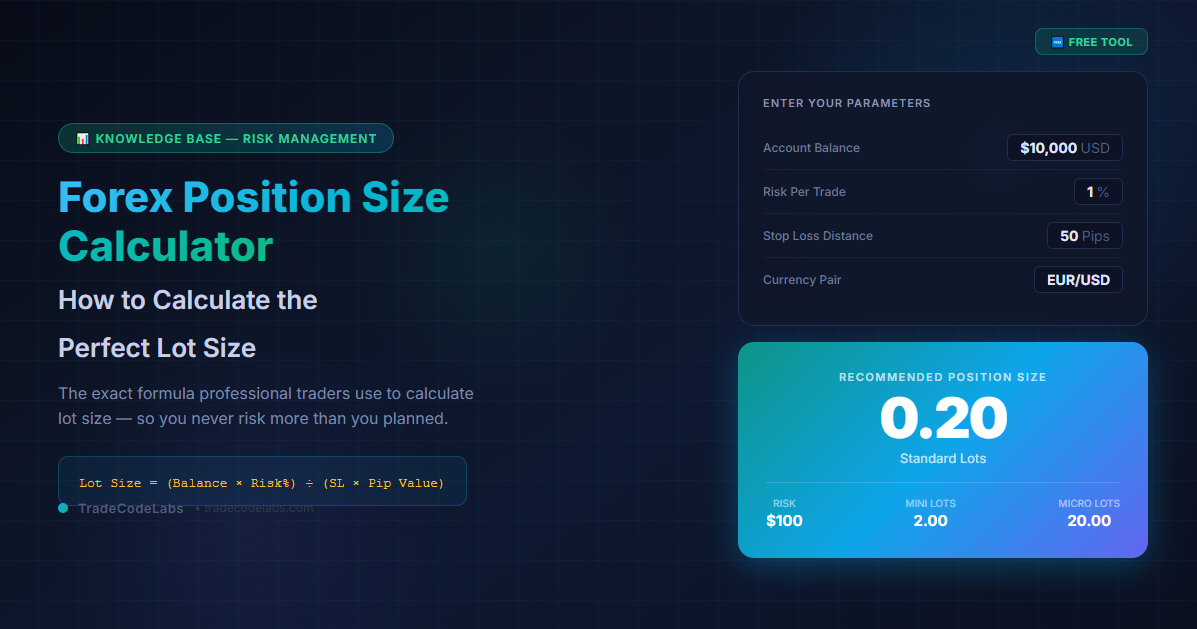
Learn the exact formula professional traders use to calculate the correct lot size for every trade — so you never risk more than you planned.
Quick Answer: Position Size (Lots) = (Account Balance × Risk %) ÷ (Stop Loss in Pips × Pip Value per Standard Lot). For a $10,000 account risking 1% with a 50-pip stop loss on EUR/USD: (10,000 × 0.01) ÷ (50 × $10) = 0.20 lots. Skip to the free calculator →
Why Position Sizing Is the Most Important Skill in Forex
Most traders spend hundreds of hours studying chart patterns, indicators, and entry strategies. They’ll backtest for weeks, optimize parameters, and read every book on technical analysis.
Then they open a trade with a random lot size.
This single mistake — not calculating position size correctly — is the #1 reason traders blow accounts. Not bad entries. Not bad strategies. Wrong position sizing.
Here’s why: even a strategy with a 60% win rate will blow your account if you risk 10% per trade. After just 7 consecutive losses (which happens more often than you think), you’ve lost 70% of your capital. Recovery from that kind of drawdown requires a 233% return — nearly impossible.
Position sizing is the difference between a strategy that survives and one that doesn’t.
Professional traders, prop firm traders, and fund managers all share one trait: they calculate their position size before every single trade, without exception.As Babypips’ School of Pips puts it — position sizing is the part of your trading system that tells you how much.
What Is a Position Size in Forex?
A position size is the number of currency units (expressed in lots) you buy or sell in a single trade. In forex, position sizes are measured in standardized lots:
| Lot Type | Units of Base Currency | Pip Value (EUR/USD) | Best For |
|---|---|---|---|
| Standard Lot | 100,000 units | $10 per pip | Accounts $10,000+ |
| Mini Lot | 10,000 units | $1 per pip | Accounts $1,000–$10,000 |
| Micro Lot | 1,000 units | $0.10 per pip | Accounts $100–$1,000 |
| Nano Lot | 100 units | $0.01 per pip | Accounts under $100 |
The correct position size depends on three factors:
- Your account balance — how much capital you have
- Your risk percentage — how much of that capital you’re willing to lose on this trade
- Your stop loss distance — how many pips your stop loss is from your entry
The goal is simple: calculate the exact lot size that ensures you only lose your predetermined risk amount if the trade hits your stop loss.
The Position Size Formula (Step-by-Step)
Here is the complete formula used by professional traders to calculate position size in forex:
Step 1: Calculate Your Dollar Risk
Dollar Risk = Account Balance × Risk Percentage
| Account Balance | Risk % | Dollar Risk (Max Loss) |
|---|---|---|
| $1,000 | 1% | $10 |
| $5,000 | 2% | $100 |
| $10,000 | 1% | $100 |
| $50,000 | 0.5% | $250 |
| $100,000 | 1% | $1,000 |
What risk percentage should you use?
- 1% risk per trade — The industry standard. Used by most professional traders, hedge funds, and prop firms. Allows you to survive 20+ consecutive losses without catastrophic damage.
- 2% risk per trade — Acceptable for experienced traders with proven strategies. More aggressive but still survivable.
- 0.5% risk per trade — Conservative. Ideal for new traders, high-volatility pairs (GBP/JPY, XAU/USD), or when trading with prop firm capital.
- Above 3% per trade — Dangerous. Even a 55% win rate will likely blow your account over time.
Step 2: Determine Your Pip Value
The pip value depends on the currency pair you’re trading and your account currency. For pairs where USD is the quote currency (EUR/USD, GBP/USD, AUD/USD):
- 1 standard lot = $10 per pip
- 1 mini lot = $1 per pip
- 1 micro lot = $0.10 per pip
For other pairs (USD/JPY, EUR/GBP, GBP/JPY), the pip value varies with the exchange rate. This is where a position size calculator becomes essential — it handles the conversion automatically.
Step 3: Apply the Formula
Position Size (Lots) = Dollar Risk ÷ (Stop Loss in Pips × Pip Value per Standard Lot)
Or equivalently:
Position Size = (Account Balance × Risk %) ÷ (Stop Loss × Pip Value)
Worked Examples: Position Size Calculations
Example 1: Standard Trade — EUR/USD
| Parameter | Value |
|---|---|
| Account Balance | $10,000 |
| Risk per Trade | 1% |
| Stop Loss | 50 pips |
| Pair | EUR/USD |
| Pip Value (Standard Lot) | $10 |
Calculation:
- Dollar Risk = $10,000 × 0.01 = $100
- Position Size = $100 ÷ (50 × $10) = $100 ÷ $500 = 0.20 standard lots (or 2 mini lots, or 20 micro lots)
Result: If EUR/USD moves 50 pips against you, you lose exactly $100 — which is exactly 1% of your account. No more, no less.
Example 2: Tight Stop Loss — GBP/USD
| Parameter | Value |
|---|---|
| Account Balance | $5,000 |
| Risk per Trade | 2% |
| Stop Loss | 20 pips |
| Pair | GBP/USD |
| Pip Value (Standard Lot) | $10 |
Calculation:
- Dollar Risk = $5,000 × 0.02 = $100
- Position Size = $100 ÷ (20 × $10) = $100 ÷ $200 = 0.50 standard lots
Key insight: A tighter stop loss means a LARGER position size. This is why scalpers (small SL) can trade bigger lots than swing traders (wide SL) while risking the same percentage.
Example 3: Wide Stop Loss — XAU/USD (Gold)
| Parameter | Value |
|---|---|
| Account Balance | $25,000 |
| Risk per Trade | 1% |
| Stop Loss | 100 pips |
| Pair | XAU/USD |
| Pip Value (Standard Lot) | $10 |
Calculation:
- Dollar Risk = $25,000 × 0.01 = $250
- Position Size = $250 ÷ (100 × $10) = $250 ÷ $1,000 = 0.25 standard lots
Key insight: Gold has wider spreads and bigger swings. A 100-pip stop loss on gold is normal — and the position size calculation automatically reduces your lot size to keep the dollar risk constant.
Example 4: Small Account — Micro Lots
| Parameter | Value |
|---|---|
| Account Balance | $500 |
| Risk per Trade | 1% |
| Stop Loss | 30 pips |
| Pair | EUR/USD |
Calculation:
- Dollar Risk = $500 × 0.01 = $5
- Position Size = $5 ÷ (30 × $10) = $5 ÷ $300 = 0.017 lots (approximately 0.02 lots or 2 micro lots)
Key insight: With small accounts, you’ll often need micro lots to maintain proper risk management. Never increase your lot size just because micro lots “feel” too small. Position sizing is math, not feelings.
Common Position Sizing Mistakes (And How to Avoid Them)
Mistake #1: Using the Same Lot Size on Every Trade
Many traders pick a lot size (like 0.10) and use it on every trade regardless of the stop loss distance. This means:
- A trade with a 20-pip SL risks $20
- A trade with a 100-pip SL risks $100
Your risk is completely inconsistent. Some trades risk 5× more than others. The fix: Calculate position size for EVERY trade individually. Same risk percentage, different lot sizes.
Mistake #2: Risking Too Much Per Trade
The most dangerous mistake. Risking 5-10% per trade feels fine during a winning streak. Then you hit 4 losses in a row (which WILL happen) and you’ve lost 20-40% of your account.
Recovery math is brutal:
| Drawdown | Return Needed to Recover |
|---|---|
| 10% loss | 11% return needed |
| 20% loss | 25% return needed |
| 30% loss | 43% return needed |
| 50% loss | 100% return needed |
| 70% loss | 233% return needed |
At 1% risk per trade, 10 consecutive losses = 10% drawdown. You need an 11% return to recover. Manageable.
At 5% risk per trade, 10 consecutive losses = 50% drawdown. You need a 100% return just to get back to breakeven. Game over for most traders.
Mistake #3: Not Accounting for Pip Value Differences
EUR/USD has a standard pip value of $10 per lot. But USD/JPY, EUR/GBP, and exotic pairs have different pip values that change with exchange rates.
If you calculate your lot size assuming $10 per pip on a pair where the actual pip value is $7.50, you’re over-risking by 33%.
The fix: Use a position size calculator that automatically calculates the correct pip value for your chosen pair.
Mistake #4: Ignoring Spread and Slippage
Your effective stop loss includes the spread. If your stop loss is 20 pips and the spread is 2 pips, your actual risk is 22 pips. On volatile pairs like GBP/JPY (spreads of 3-5 pips), this can add 15-25% to your actual risk.
The fix: Add the average spread to your stop loss distance before calculating position size.
Position Sizing for Prop Firm Traders
If you’re trading with a prop firm (FTMO, MyForexFunds, The Funded Trader, etc.), position sizing becomes even more critical. Most prop firms have strict rules:
| Rule | Typical Limit | How Position Sizing Helps |
|---|---|---|
| Daily Drawdown | 5% of account | Limit risk to 0.5-1% per trade — you can take 5-10 trades before hitting the limit |
| Overall Drawdown | 10% of account | Cap cumulative risk — never have more than 3% total exposure at once |
| Consistency Rule | No single day > 40% of profits | Smaller position sizes create more consistent P&L distribution |
Prop firm position sizing formula:
Use 0.5% risk per trade for prop firm challenges. This gives you a 10-trade buffer before hitting the daily drawdown limit, and a 20-trade buffer before the overall drawdown limit.
For a $100,000 prop firm account:
- 0.5% risk = $500 per trade
- With a 50-pip SL: 0.5 ÷ (50 × $10) = 1.0 lot
- Maximum 3 trades open simultaneously = 1.5% total exposure
How to Use the Free Position Size Calculator
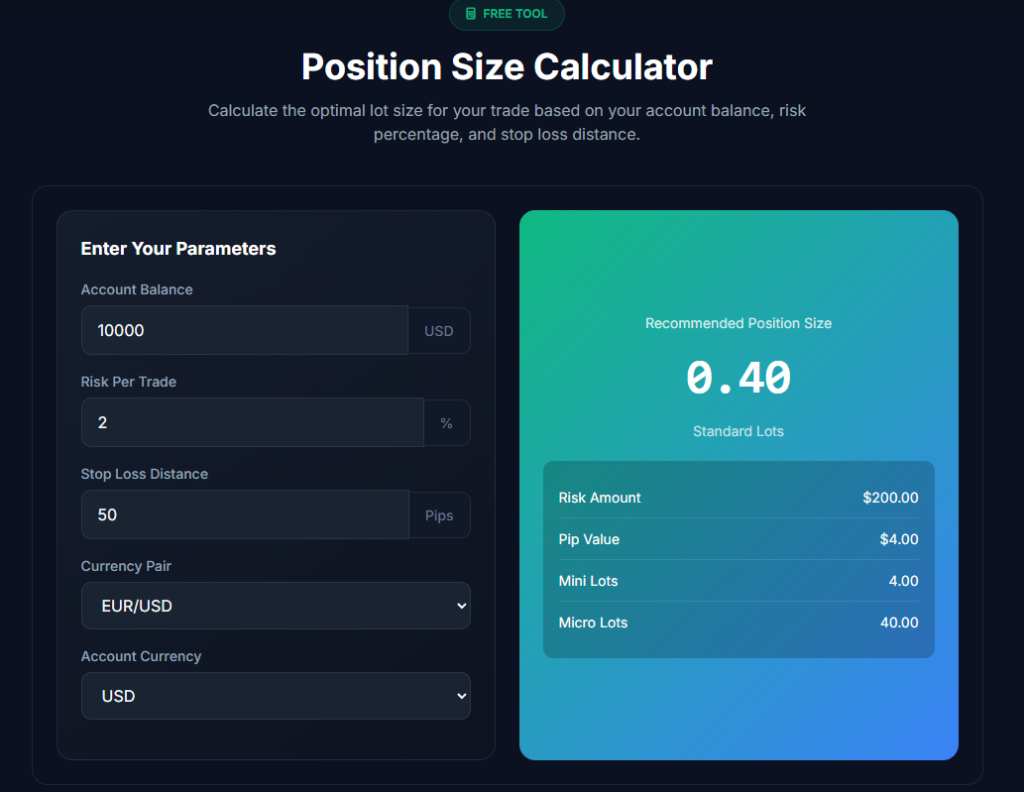
Instead of calculating manually every time, use our free Position Size Calculator. It handles all the math instantly:
- Enter your account balance — your total trading capital
- Set your risk percentage — we recommend 1% (or 0.5% for prop firms)
- Enter your stop loss in pips — the distance from entry to your stop loss
- Select your currency pair — the calculator auto-adjusts pip value
- Read your position size — use this exact lot size in your trade
The calculator accounts for real-time exchange rates, handles cross-pair pip value conversions, and works for all major, minor, and exotic forex pairs.
→ Open the Free Position Size Calculator
Position Sizing Cheat Sheet
Print this out or bookmark it for quick reference:
| Account Size | 1% Risk | 25-pip SL | 50-pip SL | 100-pip SL |
|---|---|---|---|---|
| $1,000 | $10 | 0.04 lots | 0.02 lots | 0.01 lots |
| $5,000 | $50 | 0.20 lots | 0.10 lots | 0.05 lots |
| $10,000 | $100 | 0.40 lots | 0.20 lots | 0.10 lots |
| $25,000 | $250 | 1.00 lots | 0.50 lots | 0.25 lots |
| $50,000 | $500 | 2.00 lots | 1.00 lots | 0.50 lots |
| $100,000 | $1,000 | 4.00 lots | 2.00 lots | 1.00 lots |
Pip values based on EUR/USD ($10 per standard lot per pip). Actual values vary by pair.
Integrating Position Sizing With Your Trading Strategy
Position sizing works best when combined with a complete risk management framework:
- Use a fixed risk percentage — 1% per trade is the professional standard
- Set your stop loss FIRST — based on your strategy (support/resistance, ATR, or structure), not an arbitrary number
- Calculate position size — using the formula or our free calculator
- Limit total exposure — never have more than 3-5% of your account at risk across all open trades
- Check correlation — if you’re trading multiple pairs, use a correlation matrix to avoid doubling risk on correlated pairs
- Scale down after losses — if you hit a 5% drawdown, reduce risk to 0.5% until you recover
Want automated risk management on your charts? Check out the complete TCL indicator library — including Auto Supply & Demand for identifying key stop loss levels and Auto Fibonacci for calculating precise take profit targets.

No comments yet. Start the conversation!
Leave a Comment